Etherean to Crypto Moderate, Part 2: Building
2026 May 10
See all posts
Etherean to Crypto Moderate, Part 2: Building
After RC, I took a job at Paxos because, aside from practical reasons
like it let me stay in NYC, I interviewed with some engineers who seemed
to share this "World Computer" vision.
I spent the next two years at Paxos building an in-house tokenization
stack. While Bitcoin theoretically allowed for tokens in the form of "coloured coins,"
Ethereum's full programmability allowed for much more straightforward
constructions of tokens which can represent anything. But why tokenize
anything in the first place? Tokenization of real world assets (RWAs)
made sense to me from the point of view of programmability, speed and
global accessibility. If we can get a representation of an asset into
the "World Computer" then transferring or exchanging it with anyone in
the world becomes a simple execution of instructions in the Ethereum
Virtual Machine (EVM). In the long run, that should compress things like
remittance fees, exchange fees and ameliorate the slowness of
correspondent banking. Balaji Srinivasan wrote a piece around this time
"And
what has the blockchain ever done for us" which pointed out the
extent to which the improved speed and cost was already happening.
People holding the tokenized RWA still have to trust the issuer of the
RWA like before, but there is a real net win for society by reducing the
cost of transactions through technological means. I was so focused on
simply learning a whole bunch of backend web development, cryptography
and security that I didn't re-evaluate the product side of things much
beyond that.
We first launched a USD stablecoin PAX (later rebranded to USDP) and
then a more generalized platform which was used to launch others like
USDG and PYUSD. We also looked beyond dollars and built a gold token
PAXG. I recall telling a finance friend about PAXG and his first
question was "hmm and so why not a gold ETF?" Again the programmability,
speed and global accessibility seemed obviously better to me. The token
can change hands to anyone in the world instantly, not only people who
have access to the NYSE/NASDAQ. Programmability opens the door to future
applications we hadn't even yet dreamed of. He didn't seem particularly
convinced. The existing ETF infrastructure already allowed efficient
exchanging of assets. Trillions flowed through it today. There is an
enormous amount of inertia. It dawned on me how much of an undertaking
real crypto adoption would be. It seemed clear it'd still happen
eventually, but the conversation increased my timelines for real
structural change.
The other oft-discussed RWA to tokenize is stocks. At Paxos, we tried
that too. The logic was "hey the DTCC has to hold onto billions in
reserves for counter party risk to facilitate clearance," the counter
party risk can be removed if we insert a credibly neutral blockchain in
the middle. That would free up billions in capital to be put to more
productive use. Ultimately the experiment fizzled out as the regulatory
requirements around security clearance proved too onerous for a start up
to take on.
The reality of working in any frontier area of technology is that the
applications and implications are never fully resolved before anything
is built. It's an iterative process of building, thinking, pivoting and
trying again. Near the end of my time at Paxos, I started to probe
deeper on the question of what tokenization achieves even while we were
heads down building it. Could we achieve the same thing with plain old
APIs? What do we really get with this shared computer? The mental model
of a pre-blockchain cross entity transaction I had was essentially
"operator of database A tells operator of database B to make an update."
For example, a wire transfer where a customer wants to move money from
one bank to another:
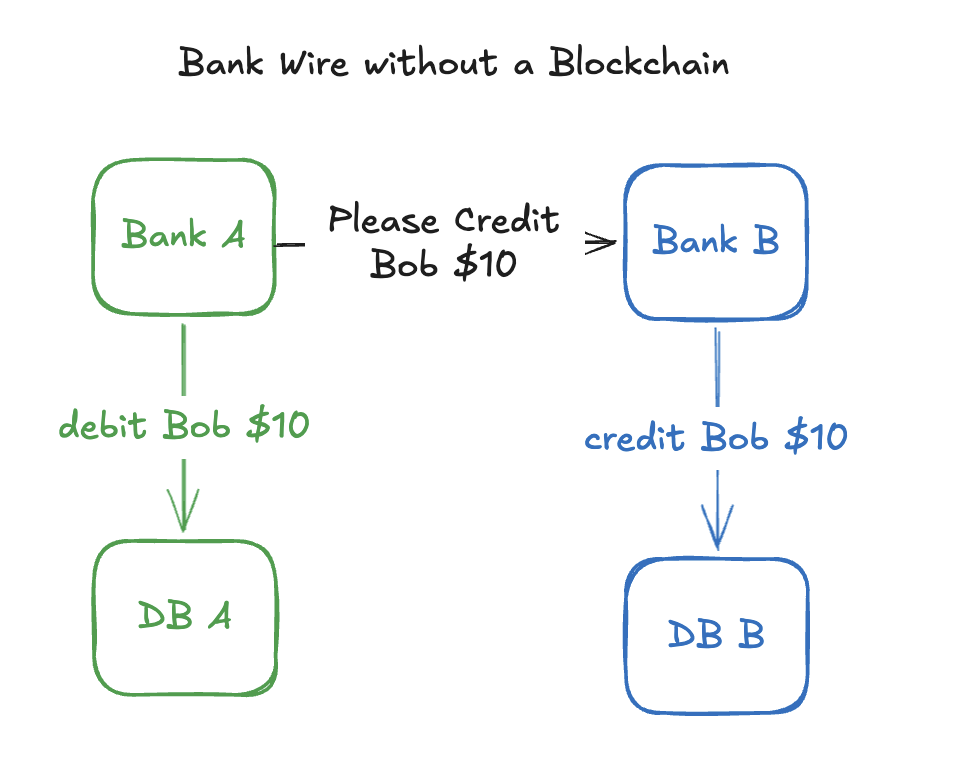
If the receiving bank can trust the sending bank through some means,
then indeed that operation works fine with APIs. That's essentially how
bank wires work today. Banks send messages (e.g. SWIFT) to each other to
then update their respective databases. If the receiver doesn't trust
the sender, then that system doesn't work because operator A can't
necessarily rely on operator B to do the database update and vice versa.
It's fundamentally an atomic commit
problem: I want either both databases to be updated correctly or
neither. The same wire, but with the backend swapped out for a
blockchain like Ethereum looks like this:
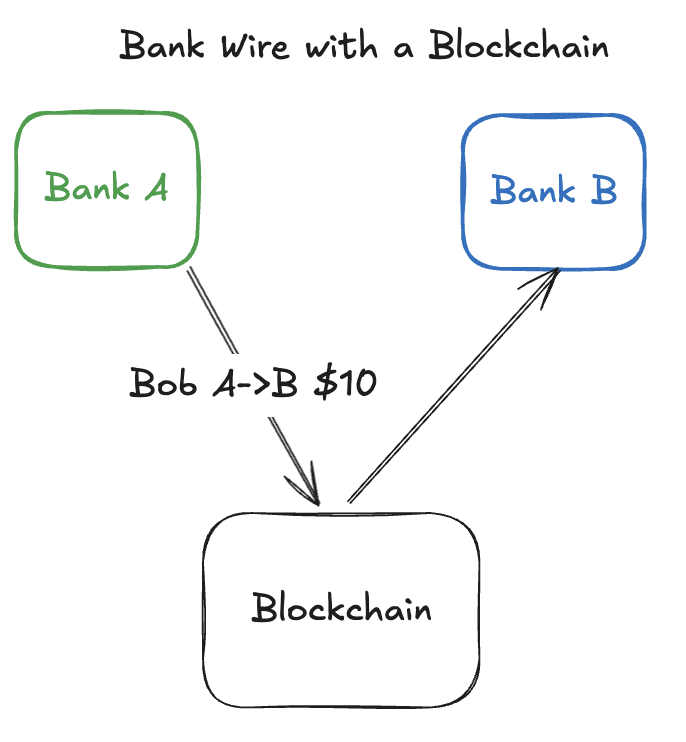
The novelty of the blockchain is that mutually distrusting parties
can update each other's state atomically. For asset trading in
particular, that means there simply is no counter party risk. Two random
people on the internet can exchange assets directly with each other,
where the intermediary isn't a bank/company, it's a global ledger. The
"distrusting" part is crucial. If there's a way to build trust between
the parties or trust an intermediary, then regular APIs suffice.
2020 was known as DeFi (decentralized finance) summer. Billions
started to flow through protocols like Aave and Uniswap for the first
time ever. I recall Hasu calling it
something like an "organic blossoming of real retail usage." The World
Computer was being used for global peer to peer asset trading and
lending at a much greater scale. I myself started using the stuff more:
setting up a hardware wallet and trying out protocols with small amounts
of money. As a Canadian living in the US with bank accounts in both
countries, I actually used a crypto route (Coinbase
->USDC->1inch-> CADC-> Paytrie) to move USD into my Canadian
bank account for cheaper than even leading fintech services like Wise.
The tokenization stack at Paxos felt tangential to this exciting new
DeFi wave. I wanted to get more into the weeds of DeFi so I joined
Chainlink Labs in late 2020 which seemed to underpin most of the major
DeFi protocols.
At Chainlink I'd spend the next 5 years working primarily on
interoperability. I was still generally an Etherean (even more so after
in 2022 they successfully transitioned to PoS, reducing the energy costs
dramatically), but unfortunately it became clear that no one blockchain
would become the sole "World Computer." That was a naive vision. The
Cosmos thesis
was ultimately correct: unlike HTTP which did in fact become the sole
winner of web communication protocols, blockchains have inherent
security and scalability tradeoffs which necessarily vary by
application. Solana gaining real traction in 2021/2022 solidified the
idea that Ethereum would not be a winner take all blockchain. My sense
was that blockchains would follow the path of operating systems or
programming languages. There would end up being a small handful of them,
all with their own ecosystems and significant friction between the
ecosystems. Even as a technical user with multiple years of experience,
I found the multi-chain UX burdensome and a clear barrier to adoption.
Ethereum's scaling
strategy of layer 2 (L2s) blockchains compounded the problem as
these L2s functioned like separate chains from a UX standpoint. So
interoperability felt like a meaningful, foundational problem to work on
and I invested heavily in contributing to that area.
While working on interoperability, I attended technical crypto
conferences more often (IC3 2022, DevCon 2022, EthCC 2023 etc.) and met
several people who had been in the space even longer than me or were VCs
who spent significant time thinking about the industry much more
broadly. Those conversations prompted me to think more deeply about
where all this is going and increasingly through the lens of a VC who
cares a lot about PMF, adoption and real users/revenue. I certainly
wasn't alone. The bear market of 2022 prompted a lot of people in the
industry to "rediscover" basic metrics of startups like revenue and
examine projects with a more critical, pragmatic eye.
Next in the series: Etherean to Crypto
Moderate, Part 3: Doubt
Questions or comments? Email feedback@cstein.xyz
Etherean to Crypto Moderate, Part 2: Building
2026 May 10 See all postsAfter RC, I took a job at Paxos because, aside from practical reasons like it let me stay in NYC, I interviewed with some engineers who seemed to share this "World Computer" vision.
I spent the next two years at Paxos building an in-house tokenization stack. While Bitcoin theoretically allowed for tokens in the form of "coloured coins," Ethereum's full programmability allowed for much more straightforward constructions of tokens which can represent anything. But why tokenize anything in the first place? Tokenization of real world assets (RWAs) made sense to me from the point of view of programmability, speed and global accessibility. If we can get a representation of an asset into the "World Computer" then transferring or exchanging it with anyone in the world becomes a simple execution of instructions in the Ethereum Virtual Machine (EVM). In the long run, that should compress things like remittance fees, exchange fees and ameliorate the slowness of correspondent banking. Balaji Srinivasan wrote a piece around this time "And what has the blockchain ever done for us" which pointed out the extent to which the improved speed and cost was already happening. People holding the tokenized RWA still have to trust the issuer of the RWA like before, but there is a real net win for society by reducing the cost of transactions through technological means. I was so focused on simply learning a whole bunch of backend web development, cryptography and security that I didn't re-evaluate the product side of things much beyond that.
We first launched a USD stablecoin PAX (later rebranded to USDP) and then a more generalized platform which was used to launch others like USDG and PYUSD. We also looked beyond dollars and built a gold token PAXG. I recall telling a finance friend about PAXG and his first question was "hmm and so why not a gold ETF?" Again the programmability, speed and global accessibility seemed obviously better to me. The token can change hands to anyone in the world instantly, not only people who have access to the NYSE/NASDAQ. Programmability opens the door to future applications we hadn't even yet dreamed of. He didn't seem particularly convinced. The existing ETF infrastructure already allowed efficient exchanging of assets. Trillions flowed through it today. There is an enormous amount of inertia. It dawned on me how much of an undertaking real crypto adoption would be. It seemed clear it'd still happen eventually, but the conversation increased my timelines for real structural change.
The other oft-discussed RWA to tokenize is stocks. At Paxos, we tried that too. The logic was "hey the DTCC has to hold onto billions in reserves for counter party risk to facilitate clearance," the counter party risk can be removed if we insert a credibly neutral blockchain in the middle. That would free up billions in capital to be put to more productive use. Ultimately the experiment fizzled out as the regulatory requirements around security clearance proved too onerous for a start up to take on.
The reality of working in any frontier area of technology is that the applications and implications are never fully resolved before anything is built. It's an iterative process of building, thinking, pivoting and trying again. Near the end of my time at Paxos, I started to probe deeper on the question of what tokenization achieves even while we were heads down building it. Could we achieve the same thing with plain old APIs? What do we really get with this shared computer? The mental model of a pre-blockchain cross entity transaction I had was essentially "operator of database A tells operator of database B to make an update." For example, a wire transfer where a customer wants to move money from one bank to another:
If the receiving bank can trust the sending bank through some means, then indeed that operation works fine with APIs. That's essentially how bank wires work today. Banks send messages (e.g. SWIFT) to each other to then update their respective databases. If the receiver doesn't trust the sender, then that system doesn't work because operator A can't necessarily rely on operator B to do the database update and vice versa. It's fundamentally an atomic commit problem: I want either both databases to be updated correctly or neither. The same wire, but with the backend swapped out for a blockchain like Ethereum looks like this:
The novelty of the blockchain is that mutually distrusting parties can update each other's state atomically. For asset trading in particular, that means there simply is no counter party risk. Two random people on the internet can exchange assets directly with each other, where the intermediary isn't a bank/company, it's a global ledger. The "distrusting" part is crucial. If there's a way to build trust between the parties or trust an intermediary, then regular APIs suffice.
2020 was known as DeFi (decentralized finance) summer. Billions started to flow through protocols like Aave and Uniswap for the first time ever. I recall Hasu calling it something like an "organic blossoming of real retail usage." The World Computer was being used for global peer to peer asset trading and lending at a much greater scale. I myself started using the stuff more: setting up a hardware wallet and trying out protocols with small amounts of money. As a Canadian living in the US with bank accounts in both countries, I actually used a crypto route (Coinbase ->USDC->1inch-> CADC-> Paytrie) to move USD into my Canadian bank account for cheaper than even leading fintech services like Wise. The tokenization stack at Paxos felt tangential to this exciting new DeFi wave. I wanted to get more into the weeds of DeFi so I joined Chainlink Labs in late 2020 which seemed to underpin most of the major DeFi protocols.
At Chainlink I'd spend the next 5 years working primarily on interoperability. I was still generally an Etherean (even more so after in 2022 they successfully transitioned to PoS, reducing the energy costs dramatically), but unfortunately it became clear that no one blockchain would become the sole "World Computer." That was a naive vision. The Cosmos thesis was ultimately correct: unlike HTTP which did in fact become the sole winner of web communication protocols, blockchains have inherent security and scalability tradeoffs which necessarily vary by application. Solana gaining real traction in 2021/2022 solidified the idea that Ethereum would not be a winner take all blockchain. My sense was that blockchains would follow the path of operating systems or programming languages. There would end up being a small handful of them, all with their own ecosystems and significant friction between the ecosystems. Even as a technical user with multiple years of experience, I found the multi-chain UX burdensome and a clear barrier to adoption. Ethereum's scaling strategy of layer 2 (L2s) blockchains compounded the problem as these L2s functioned like separate chains from a UX standpoint. So interoperability felt like a meaningful, foundational problem to work on and I invested heavily in contributing to that area.
While working on interoperability, I attended technical crypto conferences more often (IC3 2022, DevCon 2022, EthCC 2023 etc.) and met several people who had been in the space even longer than me or were VCs who spent significant time thinking about the industry much more broadly. Those conversations prompted me to think more deeply about where all this is going and increasingly through the lens of a VC who cares a lot about PMF, adoption and real users/revenue. I certainly wasn't alone. The bear market of 2022 prompted a lot of people in the industry to "rediscover" basic metrics of startups like revenue and examine projects with a more critical, pragmatic eye.
Next in the series: Etherean to Crypto Moderate, Part 3: Doubt
Questions or comments? Email feedback@cstein.xyz